Denbigh Friary Church
Visitor notice
Denbigh Friary Church is currently closed, our teams are working to reopen the church as quickly as possible and we apologise for any inconvenience.
Thank you
The Cadw team.
Ruined religious settlement laid low by Henry VIII
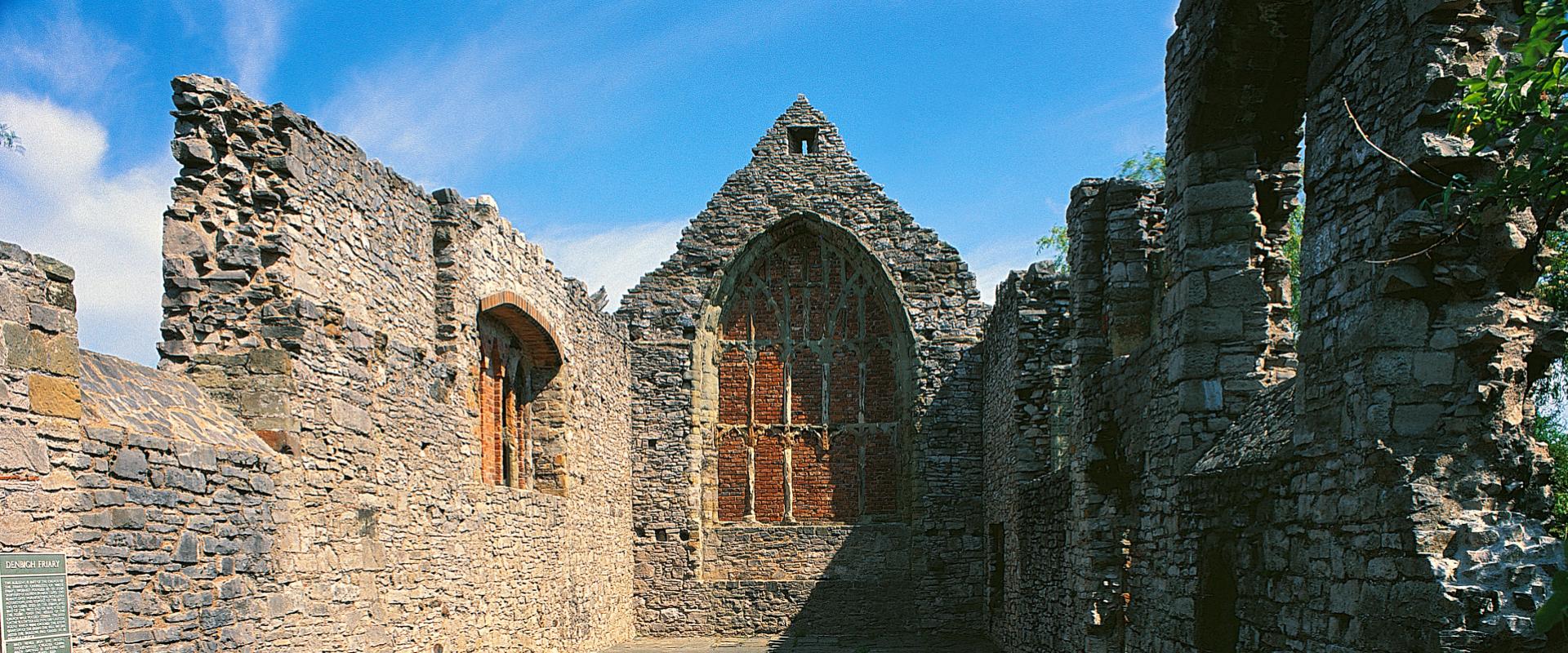
Founded by Carmelites (also known as the White Friars) in the 13th century, Denbigh Friary was a place of worship for both holy men and unordained laypeople. During services the congregation would be split, the friars in ornate choir stalls on the eastern side and the laity in a separate space to the west.
The Friary was suppressed under the orders of Henry VIII in 1538 and all that remains today are the church walls. Following its dissolution, the church found a number of other uses, including as a dwelling, wool store and malt house.
Opening times & prices
Opening times
| 1st April - 31st March | 10am–4pm |
|---|---|
|
Last admission 30 minutes before closing Closed 24, 25, 26 December and 1 January |
|
Visitor information

Dogs welcome
Dogs on short leads welcome to access ground floor levels of the site.

Walking difficulty
Terrain: Level 1 – Accessible

Drone policy
Please read our policy information about flying drones at Cadw monuments: read the guidance

No smoking
Smoking is not permitted.

Health & Safety
The friary is relatively flat, with paving stone underfoot. This can be uneven in places and slippery when wet.
As with all ancient monuments there is always a risk of stones being dislodged in bad weather, however, we manage this through extensive monitoring.
Climbing may result in serious injury.
There are several wild plants and flowers, although these are great pollinators, they may be poisonous to visitors and animals, we strongly advise you not to touch or allow dogs to eat any vegetation.
Please watch our health & safety film before visiting Cadw sites.
Iechyd a Diogelwch / Health and Safety
Please report any anti-social behaviour such as climbing, setting fires, graffiti etc. to CadwAccidentsReports@gov.wales
The following signs can be found around the site at key areas of risk, please pay attention where appropriate.

Slippery or uneven surfaces

Falling masonry
Directions
Google MapNo designated parking
what3words: ///thus.dirt.absent
Unlimited access to Wales' past
Join Cadw for as little as £2.00 a month and gain unlimited access to over 100 historical sites.
Enjoy the many benefits of Cadw membership
- 10% off Cadw gift shops
- 50% off entry to English Heritage and Historic Scotland sites
- FREE entry to English Heritage and Historic Scotland on renewal
- FREE entry to Manx National Heritage properties
- FREE membership pack including car sticker and full colour map