Margam Stones Museum
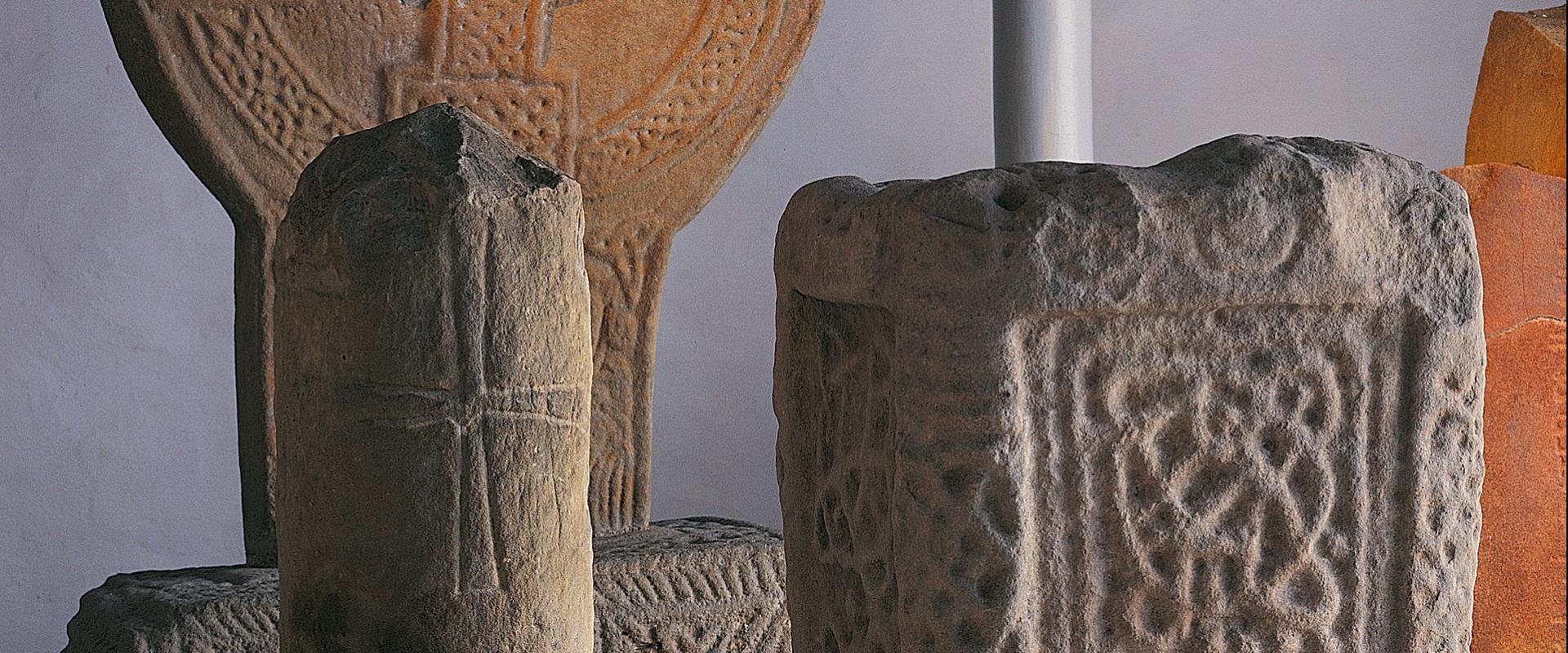
Magnificent carved stones reach back to the dawn of Christianity in Wales
This little building next door to the medieval abbey church is fascinating in its own right – it’s one of the earliest church schools in Wales. But the real story lies inside.
There you’ll find a remarkable collection of nearly 30 inscribed stones and crosses, some dating from the early days of Christianity in sixth-century Wales. These originally stood as milestones on Roman roads – or in one case on top of a Bronze Age barrow– and were recycled in memory of local chieftains.
Later sculptured stones include magnificent disc-headed and cart-wheel crosses from the ninth and 10th centuries, such as the great Cross of Cobelin with its carved hunting scene.
In the upstairs gallery, among the medieval sculptures and inscriptions from Margam Abbey, is an effigy of a 14th century knight. He’s dressed in chain mail with a small dragon at the foot of his shield. But the star of the show may be the grotesque gargoyle designed to void rainwater via its backside.
Opening times & prices
Opening times
| 1st April - 30th September | Limited opening |
|---|---|
| 1st October - 31st March | Closed |
|
Apr-Sept: Wednesday, Saturday, Sunday and Bank Holidays from 10amؘ–3pm Last admission 30 minutes before closing. Oct-Mar: The museum is now closed and only available to be opened for pre-arranged group visits of 10 or more with a notice period of least 2 weeks. To request a visit please email: CadwEstatesandProperty@gov.wales |
|
Visitor information

Car park
Parking for 15 cars adjacent to museum.
No specific disabled person parking areas.

Disabled person access
Museum on two levels. No access to upper floor for wheelchair users
Car park close to museum, level path/road to door.
No specific disabled person parking.

Walking difficulty
Terrain: Level 1 – Accessible

Museum
On-site museum.

Guidebook
Site guidebook available to purchase in selected visitor centres.

Drone policy
Please read our policy information about flying drones at Cadw monuments: read the guidance

No smoking
Smoking is not permitted.

Health & Safety
Care and attention must be paid when visiting this monument. The grounds outside are exposed to the natural elements and maybe slippery or muddy underfoot. Appropriate footwear for the season must be considered prior to your visit.
Built historic environments are sometimes uneven underfoot with steps that are narrow, steep with varying step height. Care must be paid when accessing upper levels and mezzanine / balcony spaces.
There are often high thresholds and low door frames when passing into and through indoor spaces. We kindly ask that any handrail provided is used appropriately and there is no climbing upon or within the monument.
Guardrails have been installed to prevent access to any areas of the site that we have deemed as dangerous or to prevent falls in specific areas. Please do not climb over or through any fixed installation.
As with all ancient monuments there is always a risk of stones being dislodged in bad weather, however, we manage this through extensive monitoring.
Climbing may result in serious injury.
There are several wild plants and flowers, although these are great pollinators, they may be poisonous to visitors and animals, we strongly advise you not to touch or allow dogs to eat any vegetation.
Please watch our health & safety film before visiting Cadw sites.
Iechyd a Diogelwch / Health and Safety
Please report any anti-social behaviour such as climbing, setting fires, graffiti etc. to CadwAccidentsReports@gov.wales
The following signs can be found around the site at key areas of risk, please pay attention where appropriate.
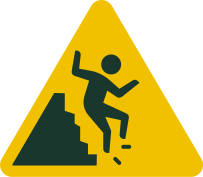
Steep and uneven steps

Slippery or uneven surfaces
Directions
Google MapPostcode SA13 2TA.
what3words: ///unwind.bookshop.jumbo

Unlimited access to Wales' past
Join Cadw for as little as £2.00 a month and gain unlimited access to over 100 historical sites.
Enjoy the many benefits of Cadw membership
- 10% off Cadw gift shops
- 50% off entry to English Heritage and Historic Scotland sites
- FREE entry to English Heritage and Historic Scotland on renewal
- FREE entry to Manx National Heritage properties
- FREE membership pack including car sticker and full colour map