St Dogmaels Abbey and Coach House
Visitor Notice
Please note the Coach House Visitor Centre and facilities are independently managed.
Please check their website for opening times at: www.stdogmaelsabbey.org.uk
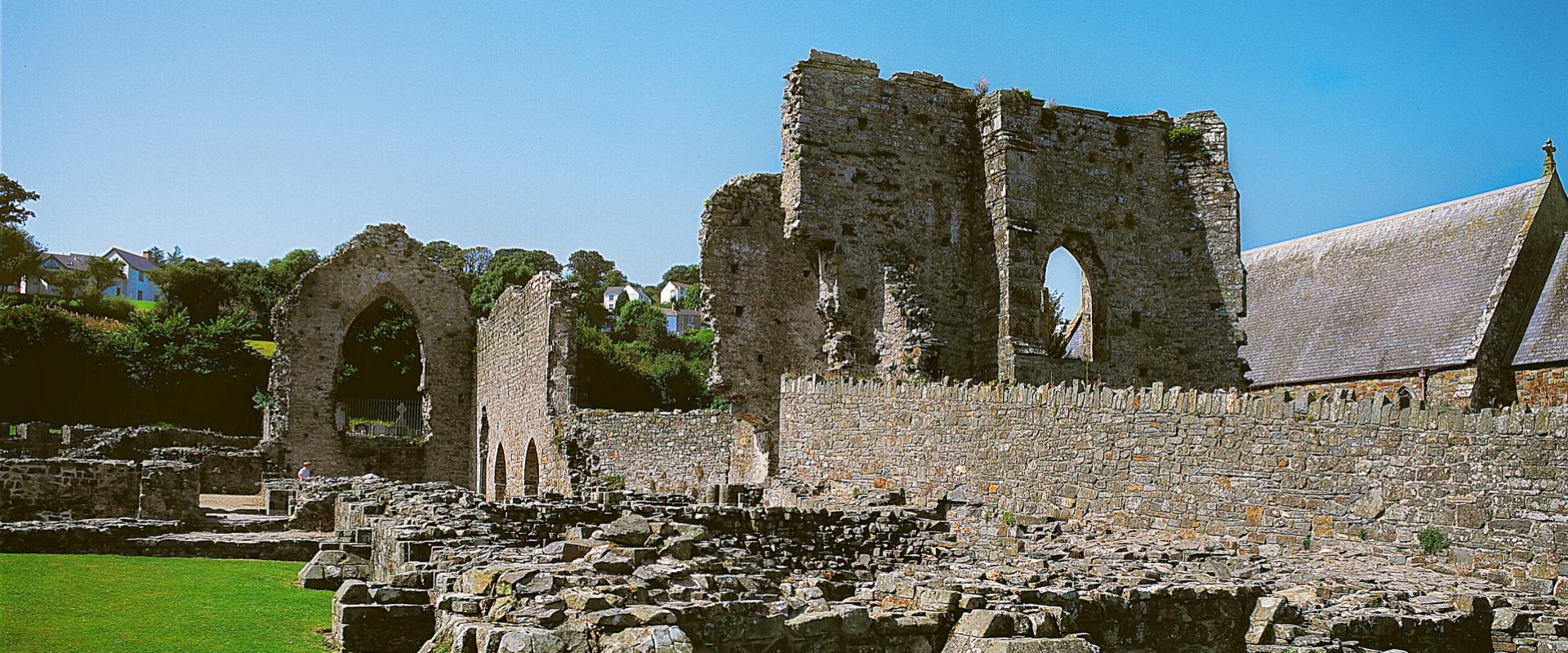
Century-spanning ruins of a significant religious settlement
Founded in 1120 on the site of an earlier pre-Norman church, St Dogmael’s status as a religious centre can be seen in extensive ruins which span four centuries of monastic life. Elements of the church and cloister are 12th century in origin, while the tall west and north walls of the nave are 13th century. There’s a fine north doorway with 14th-century decoration and a north transept, built in the Tudor period.
The abbey’s restored Coach House is now home to a museum and visitor centre that sheds light on several centuries of Christian life via artefacts that take you on a journey through time. There’s also an impressive computer-generated reconstruction of the abbey at its 15th-century peak.
Opening times & prices
Opening times
| 1st April - 31st March | Open all year |
|---|---|
|
Open all year — during reasonable daylight hours |
|
Visitor information

Accessible toilets
Accessible toilets available at this site for visitor use.

Car park
Free car parking available for visitors.

Disabled person access
Mostly sloping site with the abbey ruins situated at the top end of the site
Generally good access for walkers, but can be difficult for wheelchair users.
Abbey ruins within 100 metres of parking area.

Dogs welcome

Toilets
Visitor toilets are available at this site.

Walking difficulty
Terrain: Level 2 – Easy

Audio tour

Exhibition
On-site exhibition within monument.

Gift shop
Gift shop at this site offering a range of products and guidebooks.

Refreshments
Light refreshments are available.


Video presentation
A video presentation is available at this site.

Drone policy
Please read our policy information about flying drones at Cadw monuments: read the guidance

No smoking

Health & Safety
Situated on a grassed slope, access up to and through the monument requires the use of modern and historic steps. There are sections of smooth flooring. Take care in wet conditions as these and the grass will be slippery.
The upper section of the site will require some agility as access requires climbing over low historic threshold stone. Some of these areas are higher than others, please take care within these areas.
Guardrails have been installed to prevent access to any areas of the site that we have deemed as dangerous or to prevent falls in specific areas. Please do not climb over or through any fixed installation.
As with all ancient monuments there is always a risk of stones being dislodged in bad weather, however, we manage this through extensive monitoring.
Climbing may result in serious injury.
There are several wild plants and flowers, although these are great pollinators, they may be poisonous to visitors and animals, we strongly advise you not to touch or allow dogs to eat any vegetation.
Please watch our health & safety film before visiting Cadw sites.
Iechyd a Diogelwch / Health and Safety
Please report any anti-social behaviour such as climbing, setting fires, graffiti etc. to CadwAccidentsReports@gov.wales
The following signs can be found around the site at key areas of risk, please pay attention where appropriate.
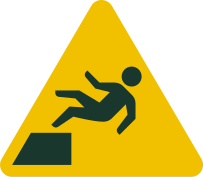
Falls from height

Slippery or uneven surfaces
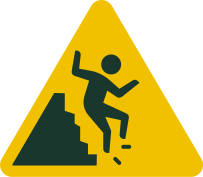
Steep and uneven steps
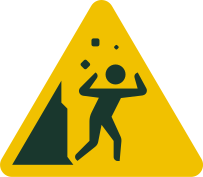
Falling masonry
Directions
Google MapPostcode SA43 3DX
what3words: ///backdrop.wiring.footpath
Unlimited access to Wales' past
Join Cadw for as little as £2.00 a month and gain unlimited access to over 100 historical sites.
Enjoy the many benefits of Cadw membership
- 10% off Cadw gift shops
- 50% off entry to English Heritage and Historic Scotland sites
- FREE entry to English Heritage and Historic Scotland on renewal
- FREE entry to Manx National Heritage properties
- FREE membership pack including car sticker and full colour map